The 8th House: The Shadow Within
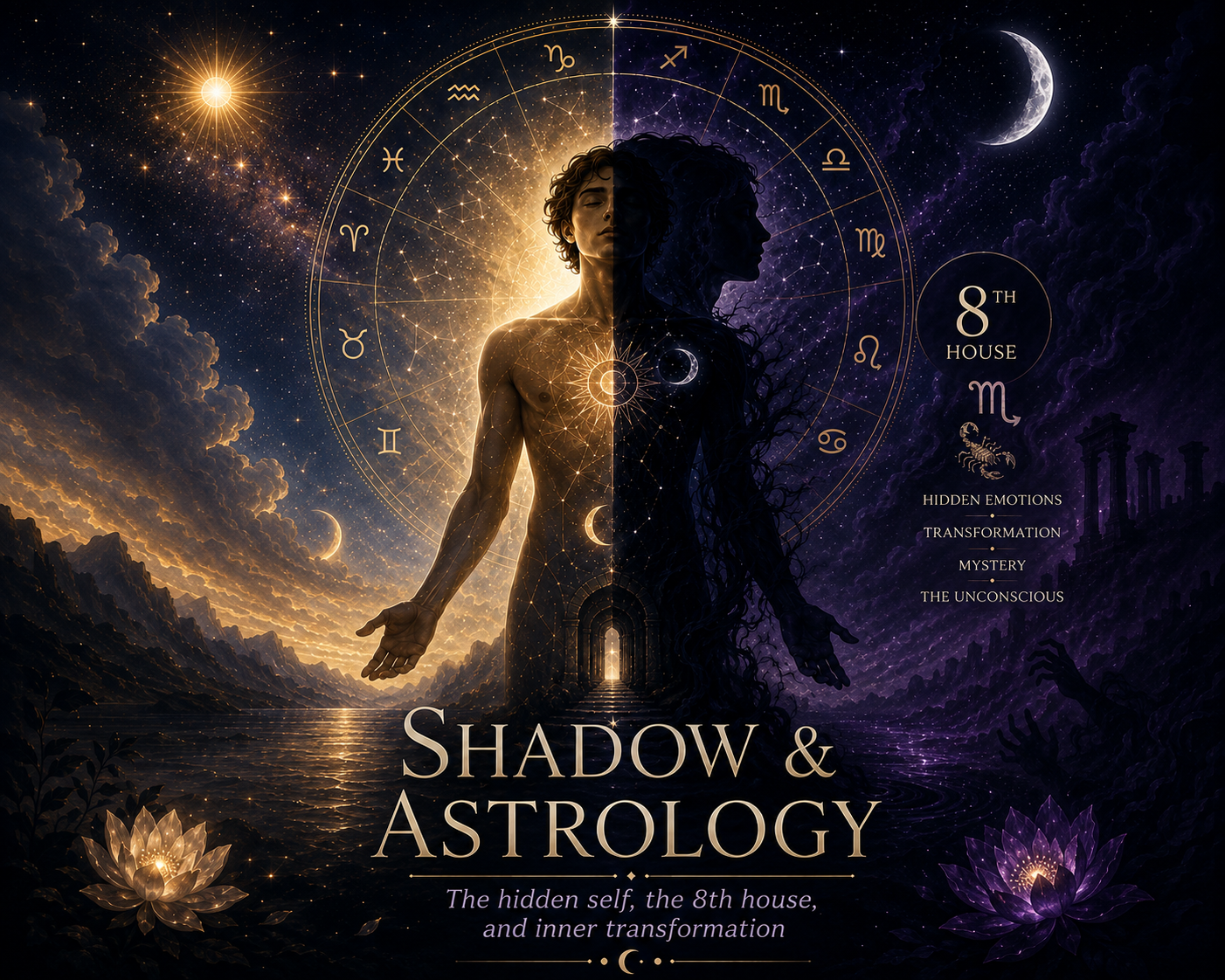
The 8th House: The Shadow Within – A Journey into the Hidden Self "The greatest battle in life is not against...
Vedic jyotish, as the name suggests, has a connection with the Vedas or the Vedic period, which is also called Vedic jyotish. But what is the real connection of this branch of astrology with the Vedas? Which part of this astrology system is connected with the Vedas? Is there any mention of astrology principles in the Vedas which we are using in this astrology system? In the Vedas, they have talked about nakshatras (27 lunar mansions), specially in the Atharva Veda and the Yajur Veda, and extensively in the Taittiriya Brahmana. They were used fundamentally for timing to do Vedic rituals and to follow the rhythms of cosmos and time itself. Other than that, there is no mention of using nakshatras for anything else in these ancient texts. So they consider the moon's cycle as it travels on these 27 nakshatras to see timing and could be used to calculate right muhurtas to do some special rituals. For example, when the moon enters Pushya nakshatra, which is the 7th nakshatra, it is considered a good time to do some Vedic rituals. So the usage of nakshatras was very limited in the Vedas. Later on, from various rishis, this subject went through a lot of evolution and was later used for predictions as well.
But like every subject, there should be some essence and basic foundation from which various principles of astrology have been derived. That essence comes from Sad-Darshanas (six schools of Vedic philosophy). These are Samkhya, Nyaya, Vaisheshika, Purva Mimamsa, Yoga Sutras, and Brahma Sutras. A lot of things come from Samkhya philosophy like Purusha and Prakriti (soul and energy), 25 Tattvas (elements), building blocks of the individual human being and universe, gunas (mental tendencies), and karmas. All these factors are building blocks which have given direction to this branch of astrology. Let's talk about each of these factors and see how they are connected with this subject.
Purusha and Prakriti: Purusha is our chitta, or we can say it is our super consciousness, which has lost its true nature, which is beyond any gunas. This Purusha was Shiva when it was in its pure form, but now it has descended due to impurities. Shiva is a vast ocean of consciousness, and Purusha is a small droplet of this sea who forgets that the ocean is his real essence. But Purusha is connected with Prakriti now and thinks he is one with this Prakriti. This Prakriti consists of three gunas: Satvic, Rajasic, and Tamasic gunas. So our atma (Purusha) now acts according to the gunas which are more predominant on Purusha.
Satvic is pure, which believes in doing good karmas, unconditional love and service to mankind, high moral values, followers of dharma, always thinks about God, and does a lot of donations and service towards the community. Rajasic people are full of desires, always have goals, are ambitious, greedy, and believe in materialistic success. They worship God, but to achieve gains and wealth. This tendency of Rajasic nature makes us more materialistic and compels us to give more value to wealth, prosperity, and relationships. Tamasic tendencies make one ignorant, in delusion, lazy, and less intelligent. A person does not believe in fulfilling their responsibilities, can ignore their loved ones' sorrows and needs, and lacks compassion and love for others. Purusha is bound with these gunas and acts according to them.
How does Prakriti accumulate these gunas? By which Prakriti binds our consciousness? From 25 Tattvas (elements): five grosser elements: Akash (space), Vayu (air), Agni (fire), Jala (water), Prithvi (earth). Then come Pancha Tanmatras (five subtle elements): Gandha (smell), Rasa (taste), Rupa (form), Sparsha (touch), Shabda (sound). Pancha Karmendriyas (five organs of action): Upastha (creative), Payu (excretion), Pada (foot), Pani (hand), Vak (speech). Pancha Gyanendriyas (five organs of cognition): Ghrana (nose), Rasana (tongue), Chakshu (eyes), Tvak (skin), Srotra (ear). Three Antahkaranas (three internal organs): Manas (mind), Buddhi (intellect), Ahamkara (ego), and two are Prakriti and Purusha. Prakriti is gunas, and as gunas, mind, intellect, and ego interact with other elements and behave and get impressions back from senses and organs of cognition. Purusha is witnessing all that, and all these impressions are stored in the form of tendencies in Pancha Tanmatras (five subtle elements), which is our subconscious mind. After our death, these subtle elements where all our mental tendencies are stored remain with our Purusha and Prakriti (gunas). Gunas come from these tendencies. So as long as Purusha remains connected with gunas, there will be rebirth. Only when such Purusha achieves the state of Gunatita (beyond gunas) is he able to get moksha.
All these factors are the essence of Vedic astrology. We use the word "Graha" for planets. Graha means eclipse or grabbing or bounding, so something which is bounding or grahan on our Prakriti, gunas, and mind. What kind of gunas will be predominated, how will the mind and intellect be developed for a child, and what his senses will perceive and bring back that knowledge through Gyana Indriyas (five organs of cognition) which will build up his manas and intellect and develop ego? As per that, he or she will use his Karmindriyas. So all is a play of these 25 elements, which develop and program our mind, intellect, and ego, and we use them according to our programming.
Where a child will be born, who are his parents, who will raise him, and what kind of samskaras (impressions) and education he will get depends upon his Prarabdha Karmas (karmas which are going to fructify in this life). Prarabdha, which is stored in Tanmatras (five subtle elements), attracts Kala (time), Desha (place), and Patras (our parents and people around us during childhood) when and where we get born. These factors define what a child's resources would be, which are needed for him to develop his intellect and mind and ego. This is what is going to make his destiny and define his success, failures, or challenges in life. So where a child gets born, at what time he is born, and what kind of parents he has is a very big event which determines his whole life. That time is so important.
How to evaluate that time and how to understand what Prarabdha (karmas) are coming in this life? And who defines time? The position of the sun and moon. When the sun rises, it is the beginning of the day, and when the sun sets, it is evening and the end of the day. So the position of the sun is very important. Also, the waxing and waning phase of the moon defines Tithis (Vedic days), which is also calculated with respect to the moon's distance from the sun. So the sun and moon are ruling time, and other planets are revolving around the sun. All these celestial phenomena have a lot to do with time, which was studied and understood by ancient rishis. With the position of all these planets with respect to the sun and the moon, they found a way to study and evaluate that time to study the Prarabdha of a child who is born at that particular time. But how? First, study which gunas will be predominated due to his Prarabdha or Tanmatras elements. The position of Jupiter, Moon, and Sun will show Satva guna. Mercury and Venus will show Rajas gunas. Saturn, Mars, and Rahu will show Tamasic. Ketu is neutral. There is a system developed by our ancient rishis to consider the strength of these planets or grahas, which suggests the predominant gunas for that native.
Now, what experiences will that native accumulate from his Gyan Indriya, which will develop his mind, intellect, and ego? We study that from Gyanindriyas. Each Gyan Indriya is connected with five planets: Ghrana (organ of smelling) with Mercury, Rasana (organ of tasting) with Venus, Chakshu (organ of seeing) with Mars, Tvak (organ of touching) with Saturn, and Srotra (organ of hearing) with Jupiter. The moon is connected with mind (Manas), the sun with ego (Ahamkara), and the ascendant with intellect (Viveka). These Gyan Indriyas and Antahkaranas (three internal organs) are a subtler form of the five grosser elements: earth, fire, air, water, and space. There is a need for deep study to understand how these elements behave and affect our behavior. But this is how our karmas, which we do from the five Karmendryas and those Pancha Tanmatras, influence us to do our karmas. When karmas are done, they get perceived by the organs of cognition in the form of knowledge, and on this knowledge, our mind, intellect, and ego get developed. With these three internal organs, we choose our karmas. So it is a way of process, and this cycle keeps going on in our life. Astrology gives us a way to understand this process of karmas, and any bondage related to one of these twenty-five elements can be understood with the help of astrology. That is the real gem which is given by our ancient rishis, and that is why they call this ancient science Jyotish, meaning the subject which gives light to understanding how to remove darkness.
The 8th House: The Shadow Within – A Journey into the Hidden Self "The greatest battle in life is not against...

Birth Chart Consultation: Discover the Deeper Meaning of Your Kundali Every individual is born with a unique combination of planetary energies....

Gemstones and Divinity : Ancient Wisdom, Planetary Connections and Vedic Astrology Gemstones and their relation with destiny have remained fascinating among...

Vedic jyotish, as the name suggests, has a connection with the Vedas or the Vedic period, which is also called...

Your rising sign, also known as the ascendant, is the zodiac sign that was ascending on the eastern horizon at...

The astrological chart is divided into twelve houses, each representing a different sphere of life—from personal identity and relationships to...

Mercury retrograde is one of the most well-known astrological phenomena, often associated with miscommunication, technology glitches, and travel disruptions. During...

Astrology, an ancient practice rooted in the observation of celestial patterns, offers a fascinating lens through which we can better...

Astrology offers a fascinating lens through which to explore human personality and relationships. Each zodiac sign carries distinct traits that...

While the sun sign often takes center stage, the moon's influence in astrology is profound and deeply personal. The moon...